Pages

Showing posts with label gamma rays. Show all posts

Tuesday, 20 March 2012

The New Indian Express gets science reporting wrong

Two days ago, a weird article appeared in the New Indian Express' opinions section, written by V Sudarshan, its executive editor (linked here). The article spoke about how low-energy nuclear reactions were "here to stay" without a single credible reference to a journal article or another report, and went on to assert that it was feasible in the tone of someone suggesting a long-awaited solution to the energy crisis.

The contents of the piece were, as such, credible: the scientists who came up with the technique had patented it and even expressed that it was good only in principle and that they hadn't taken the trouble to verify it practically. The published paper is available here and the patent report here.

Now, it's not as if just the tone of the article was amiss - if it was only that, I wouldn't be concerned. The piece read like Sudarshan had assumed a lot of numbers and techniques to make his point. If he had done his due and had gone about reporting the development as any honest science reporter would have, it would be a fantastic article capable of inspiring research in India.

# The piece opens by saying a Dr Rossi was inspired by the Fleischmann-Pons experiment of '89 to start working with cold fusion. The FP experiment was debunked and trashed few months after it came out, and anyone who was inspired by that to continue in that very line of work is not going to be taken seriously easily. Given that the latter half of the article says how Rossi's work isn't in the cold fusion category but the low-energy nuclear reactions one, the reference to the FP experiment is just counter-productive.

[caption id="" align="aligncenter" width="300" caption="Dr Andrea Rossi"][/caption]

The piece portrays the US Department of Energy as sceptics for running down cold fusion. The DoE had reasons. They weren't the only ones who ran down cold fusion: it was defenestrated by the entire scientific community!

Tip: when it comes to science reporting, please don't distort reality by leaving out the context. It's just... stupid. Who are you benefitting when you write like that? Not the academic community, not the people involved in the research, not the people. It's just an opinion. Write it like it should be written.

# Next: Rossi's device is mentioned as something that "produces lots of energy." How? When did it produce lots of energy?

The piece says Dr Rossi challenged Dr Focardi, a physicist from the University of Bologna, to find faults with the device. After Sudarshan writes that Focardi failed in his attempts, he leaves the plot hanging there to hint that the device, having been vetted by ONE physicist, actually works.

[caption id="" align="aligncenter" width="294" caption="Rossi with Dr Sergio Focardi"][/caption]

What's missing are these: Have Rossi and Focardi published the evidence of that much energy? If they haven't published it, where did you get your opinion from? If they have published it, why are you afraid to print it?

#
"Four years later, Rossi unveiled the device that amplifies energy."

How is that possible without a second source of energy to perform the amplification? If there is no second source, then the sacrosanct first law of thermodynamics stands violated! Worse yet, these are Sudarshan's words, not Rossi's, and will pass muster only when spoken by other physicists who are willing to endorse Rossi's claims with sufficient evidence.

Sudarshan should have chosen his words more carefully. For someone reading the paper whose physics education was stopped and forgotten with high school, saying energy can be amplified without a second input can bypass the importance of the first law. To illustrate another instance of Sudarshan's foot-in-mouth disease, the piece says,
"Once you have steam, it is a matter of time before it is converted into electricity."

Sounds like there are going to be 17th century alchemists on stand-by as the reaction progresses.

#
"This is how it works: a minute amount of hydrogen is heated in a lead-covered chamber ... containing nickel powder. The hydrogen converts the nickel to copper and in the process, heat is given off, as well as low energy gamma rays."

Since when does hot hydrogen convert nickel to copper? Since when does hot hydrogen convert nickel to copper and release heat?

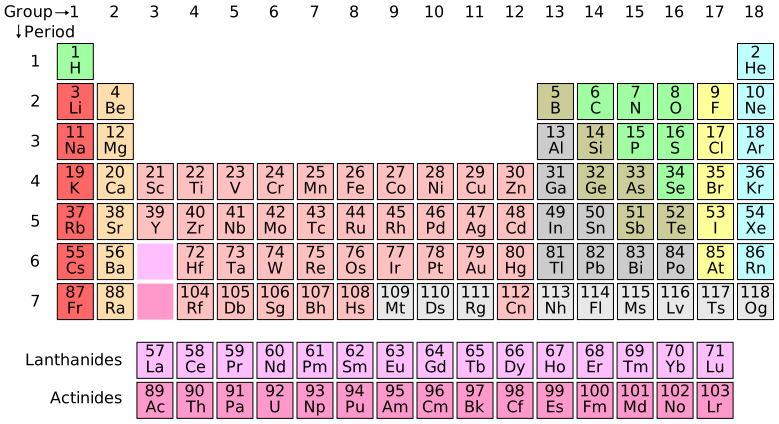
[caption id="" align="aligncenter" width="560" caption="In the Periodic Table of elements, nickel (Ni) and copper (Cu) are numbered 28 and 29, which are their respective atomic numbers (the number of protons in their nuclei)."][/caption]

The nuclear transmutation of nickel to copper is an energy-consuming reaction: the copper nucleus is heavier, meaning the nickel nucleus is more stable naturally. Because Rossi is going the other way, he must be using an isotope of nickel (a variant of the metal that contains an extra few neutrons in its nucleus while keeping the number of protons intact). Which isotope of nickel?

This is where it gets even better: Ni-48 is one of the most stable isotopes on the planet, Ni-56 is produced by supernovae and not available easily on Earth, Ni-58 - the most abundant - forms by the decay of copper-58, Ni-59 and Ni-60 are available in extremely small quantities, Ni-62 is the product of nuclear fusion reactions, Ni-64 is formed by the electron-capture of copper-64, and the solar system doesn't have enough Ni-78 to have let Dr Rossi experiment with it.

What Sudarshan should have done is explained for the layman what really happens with the heating of hydrogen instead of deliberately misleading the paper's readers. When the hydrogen is heated in the presence of nickel as a catalyst, its electrons and protons are separated from each other and deposited in the spaces between nickel atoms in the metal's crystal lattice.

[caption id="" align="aligncenter" width="426" caption="The nickel crystal lattice, with the black dots indicating the positions nickel atoms will occupy"][/caption]

The remaining unpaired protons are, according to the patent, "statistically captured" by the nickel atoms. If you read the word "statistically" anywhere in a journal or patent report, it means that there's only a chance of that event happening. In other words, if the process is repeated over and over again, it will have happened enough times to warrant a practical consideration.

The rest is easy. The nickel isotope that captures a proton becomes heavier and gradually decays into an isotope of copper, releasing low-energy gamma rays. Further, the copper-isotope that results is heavier compared to its natural form, and gradually decays by emitting positrons and gamma rays. When such a positron encounters an electrons, anti-matter will meet matter and they will annihilate, releasing a gamma ray and a neutrino.

The lead encasement within which all this will occur will be capable of trapping the gamma rays and converting them into thermal energy. Another smaller source of energy is that when copper decays by the emission of gamma rays, it recoils, like a gun recoils after firing a bullet. This recoil is absorbed by the surrounding lattice of nickel atoms and gives rise to a vibration in the crystal that is slowly dissipated as heat.

The reason this proposed technique will work only in principle is that, for practical feasibility, the total amount of energy released should be demonstrably greater than the total amount of energy consumed. Otherwise, it's only an energy sink.

# With apologies for the digression, we now circle back to Sudarshan's article.
"Apparently the device heated Rossi's factory continuously for two years."

Do I dare ask where the attribution is? Why do apparent occurrences make it into a report that's supposed to be festering with hope, intent on sinking it with dubiousness? Moreover, instead of saying the device powered the factory for two years, the piece could have mentioned how much power that amounted to. There is another incidence of this "apparent" business when Sudarshan says,
"One gram of nickel apparently can produce 23,000 MW-hours of energy."

Making these many "apparent" claims makes the piece read like the work of a rumour-monger.

# Which it could easily be because the ONE reference that Sudarshan points to right at the bottom of the article is e-cat.com. Yes, the reference is not a neutral-third party or a collection of papers produced Rossi or Focardi but Rossi's website that smacks of desperation to have his solution proven practically.

This article is a discussion of the newspaper report only. If you're looking for physics of it and whether or not Dr Rossi's new device will ever see the light of day, you could go here. As a scientist put it,
"Engineering is done with numbers. Analysis without numbers is only an opinion."

Thursday, 10 November 2011

Neutron economics I

We all have misconceptions about various things, but their potential for harm is not more pronounced than it is in the case of nuclear power generation. In fact, the momentum at which the subject is gaining relevance today practically mandates that ignorance, too, can cause just as much harm. Therefore, it is important to know what goes on inside a nuclear reactor due to which it produces power, what are the different kinds of fuel used in such power plants, what the scientific principles are that dictate the process flow, and so forth.

[caption id="attachment_20602" align="aligncenter" width="600" caption="Sources: Energy Information Administration (EIA), International Energy Annual 2004 (May-July, 2006); EIA, System for the Analysis of Global markets (2007)."][/caption]

Nuclear power plants, or NPPs, are currently positioned within the proliferation stage: the threat of fossil fuel exhaustion is imminent and very real, and because of the lack of research invested in the development of plants that consume renewable energy, there approaches a developmental rupture in the future, a gap signifying the paucity of energy to sustain growth as well as the inability of forthcoming generations to comfortably define it. In light of such possibilities, nuclear power provides a suitable resource because of the following reasons.

  1. Nuclear fuel could be considered to be yet under-exploited; even though reserves of usable uranium are running out, vast quantities of thorium and its isotopes await mining. However, it should be noted that only certain isotopes can be used for fuel, and in order to obtain a few grams of them, whole quintals will have to be mined and refined.

  2. A few grams of the enriched isotope can deliver energy worth hundreds of tons of coal. At the same time, the undermining consequence is that the design of the power plant has to be such that it can withstand the generation of such amounts of energy in a matter of seconds.

  3. A nuclear fusion reaction, which hasn't yet been deployed in the capacity of power generation, is more than one-million times stronger than a corresponding fission reaction, and produces no nuclear waste (theoretically). However, the engagement of such options has been delayed worldwide not by the costs involved but by the technology required to instigate and sustain such reactions.


[caption id="attachment_20595" align="aligncenter" width="600" caption="The sun is essentially a nuclear fusion powerhouse."][/caption]


I am not writing to clarify which side of the debate (nuclear v. non-nuclear) I lie on but only to highlight the simple concepts and procedures that sustain any interest on the widespread use of NPPs. Let's begin with the fuel cycle.

 
Every atom (except hydrogen's) contains a nucleus that, in turn, contains protons and neutrons in some number. More often than not, the difference between the number of protons and the number of neutrons is 0 or 1. The protons have a positive charge, are each about 1,800 times times heavier than an electron, and are bound to the neutrons by the strongest natural force: the nuclear force. During a fission reaction, it is the sundering of this bond that yields the gargantuan amounts of energy. The electrons in the atom exist around the nucleus at multiple energy levels, which are called so because all electrons in the same level have the same amount of potential energy.

 
To set off a nuclear reaction, i.e., to break up the nucleus, the trick is to make it heavy and, thus, unstable, like a 10-kilogram dumbbell with a central bar made of straw. To make it heavier, a suitable particle has to be forced into the nucleus. Such force is necessary because of two reasons.


  1. The protons and neutrons are both heavy particles. Forcing a much-lighter electron in would have no appreciable effect on the total mass of the nucleus.

  2. The protons are positively-charged, which rules out the option of forcing extra protons into the nucleus because of the Coloumbic, or electric, repelling force.


The obvious conclusion is the use of a neutron. However, not all neutrons can be used because it is necessary that the nuclear trap the neutron, become heavier and start disintegrating instead of having the neutron zip past with no useful effect. Such slowed neutrons are called thermal neutrons, and when these thermal neutrons are captured by nuclei, the nuclei become what are called isotopes of their original form.


[caption id="attachment_20596" align="aligncenter" width="600" caption="Uranium oxide"][/caption]


Now, in the event of a neutron capture, the chances of fission reactions occurring is not 100%: the nucleus may decide to whine away the excess mass through transmutation processes called alpha- and beta-decays. Having detailed as much, it becomes much easier to understand the working of a nuclear reactor.


  1. A reactor core is readied where the nuclear reaction can take place in a controllable environment.

  2. Enriched fuel is compacted in the shape of rods and inserted into the reactor core. The more the extent of insertion, the more nuclei are available for a fission reaction.

  3. An adjacent chamber is flooded with heavy water and a source of neutrons is placed in it. (The molecular formula for water is H2O, which means each molecule contains two atoms of hydrogen. When these atoms are replaced by an isotope of hydrogen called deuterium, the resulting compound is called deuterium hydroxide or heavy water.)

  4. At a suitable position within this arrangement, a provision for control rods is provided. Made of compounds of boron or cadmium, these rods, depending on the extent of their penetration into the chamber, are used to absorb excess neutrons in the event of their proliferation.

  5. Voluminous ducts containing a coolant are coiled around the core to remove excess heat. In this case, let's assume the core is water-cooled.

  6. When the reactor is ready, the control rods are fully retracted and the neutron source is allowed to generate fast neutrons.

  7. These fast neutrons are slowed down upon collision with the surrounding heavy water molecules and become thermal neutrons.

  8. The thermal neutrons are fed into the reactor core, where they are absorbed by the nuclei in the fuel rods.

  9. A certain proportion of the nuclei begin the fissioning process, releasing massive quantities of kinetic energy, gamma radiation and more neutrons.

  10. The kinetic energy manifests as an extremely high temperature within the reactor core.

  11. The power plant's pumps are switched on and the water begins to flow in the coiled duct, across which heat is conducted and the water turns to steam. Consequently, the core cools down.

  12. The steam is passed through a throttle that converts its pressure energy into kinetic energy, i.e., accelerates the steam into a jet that is guided onto the blades of a turbine that generates power.

  13. Meanwhile, in the reactor core, even more neutrons are now available that at the start of the reaction because of the nuclear fission reactions that have already occurred.

  14. To keep from all these neutrons causing nuclear havoc, the control rods are inserted enough to keep the rate of reactions tractable.

  15. The available neutrons then continue to propagate the fission process with the remaining fuel.

  16. The steam, after striking the blades of the turbine, slows down and is collected in a condenser. The vapor is then cooled, compressed and fed once more into the coiled ducts.


This is the nuclear fission process that occurs when a sufficiently enriched isotope is the fuel. Not all isotopes can be used in an NPP for power generation. They must meet certain requirements. For example, U-235 is used because its fission products can be handled to some extent, because the required technology to control its fission reaction exists, and because isotopic uranium is available in nature.


Once a neutron has been captured, the U-235 nucleus transmutes to a U-236 nucleus and becomes highly unstable. Because of the excess energy causing the instability, it begins to oscillate and eventually "comes apart", as a result of which the nuclear force breaks down and releases a massive amount of energy. If we assume that the U-235 nucleus was at zero-energy at the beginning and if the incoming thermal neutron had an energy of 1 electron-volt (eV), the resulting explosion releases somewhere around 215 mega-electron-volt (MeV): a jump of 215 million orders. Of this output, 168 MeV is in the form of kinetic energy, 17-26 MeV of gamma rays, 12 MeV of neutrons, 8 MeV of beta particles and the remaining of other fission products.


As stated earlier, the chances of a fission reaction occurring are not 100%, and when it doesn't happen, a process called beta decay takes its place. Note the emission of beta particles in a fission reaction: these particle-groups are of two kinds.


  1. Negative beta decay: electron + electron anti-neutrino

  2. Positive beta decay: positron + electron neutrino


(A positron is the anti-particle of the electron, i.e., it weighs the same as an electron and has all its properties, except for a +1 electrical charge instead of the electron's -1.)

When beta decay is said to occur, only positive or negative beta decay occurs; not both. Now, when a neutrino/anti-neutrino strikes a positively charged nucleus, the collision in question can occur only when a weak force comes into being between the neutrino and the nucleus. This weak force is mediated by a particle called the Z boson, which is an extremely heavy particle. To lose this temporarily gained excess mass/energy, the nucleus beta decays once more to become electrically neutral.


[caption id="attachment_20599" align="aligncenter" width="502" caption="Either Ce-173 or Sr-90 placed on a sheet of Alomogordo glass in the presence of a magnetic field emits beta particles, visible as feeble curves on the sheet."][/caption]


The beta decay process is important in reactors that use thorium-232 as nuclear fuel. When a Th-232 nucleus captures a thermal neutron, it undergoes fission, emits some gamma rays, and transmutes to Th-233. Next, Th-233 undergoes negative beta decay to become Pa-233 (protactinium), which beta decays once more to yield U-233. This isotope of uranium then captures a neutron, undergoes fission, releases two more neutrons, and becomes U-232. Now, U-232 is extremely radioactive (it is a strong emitter of gamma rays) and its formation is the principle disadvantage of employing a Th-232 nuclear fission cycle.

 
Therewith concludes the discussion on the principles of a nuclear fission reaction.

Neutron economics I

We all have misconceptions about various things, but their potential for harm is not more pronounced than it is in the case of nuclear power generation. In fact, the momentum at which the subject is gaining relevance today practically mandates that ignorance, too, can cause just as much harm. Therefore, it is important to know what goes on inside a nuclear reactor due to which it produces power, what are the different kinds of fuel used in such power plants, what the scientific principles are that dictate the process flow, and so forth.

[caption id="attachment_20602" align="aligncenter" width="600" caption="Sources: Energy Information Administration (EIA), International Energy Annual 2004 (May-July, 2006); EIA, System for the Analysis of Global markets (2007)."][/caption]

Nuclear power plants, or NPPs, are currently positioned within the proliferation stage: the threat of fossil fuel exhaustion is imminent and very real, and because of the lack of research invested in the development of plants that consume renewable energy, there approaches a developmental rupture in the future, a gap signifying the paucity of energy to sustain growth as well as the inability of forthcoming generations to comfortably define it. In light of such possibilities, nuclear power provides a suitable resource because of the following reasons.

  1. Nuclear fuel could be considered to be yet under-exploited; even though reserves of usable uranium are running out, vast quantities of thorium and its isotopes await mining. However, it should be noted that only certain isotopes can be used for fuel, and in order to obtain a few grams of them, whole quintals will have to be mined and refined.

  2. A few grams of the enriched isotope can deliver energy worth hundreds of tons of coal. At the same time, the undermining consequence is that the design of the power plant has to be such that it can withstand the generation of such amounts of energy in a matter of seconds.

  3. A nuclear fusion reaction, which hasn't yet been deployed in the capacity of power generation, is more than one-million times stronger than a corresponding fission reaction, and produces no nuclear waste (theoretically). However, the engagement of such options has been delayed worldwide not by the costs involved but by the technology required to instigate and sustain such reactions.


[caption id="attachment_20595" align="aligncenter" width="600" caption="The sun is essentially a nuclear fusion powerhouse."][/caption]


I am not writing to clarify which side of the debate (nuclear v. non-nuclear) I lie on but only to highlight the simple concepts and procedures that sustain any interest on the widespread use of NPPs. Let's begin with the fuel cycle.

 
Every atom (except hydrogen's) contains a nucleus that, in turn, contains protons and neutrons in some number. More often than not, the difference between the number of protons and the number of neutrons is 0 or 1. The protons have a positive charge, are each about 1,800 times times heavier than an electron, and are bound to the neutrons by the strongest natural force: the nuclear force. During a fission reaction, it is the sundering of this bond that yields the gargantuan amounts of energy. The electrons in the atom exist around the nucleus at multiple energy levels, which are called so because all electrons in the same level have the same amount of potential energy.

 
To set off a nuclear reaction, i.e., to break up the nucleus, the trick is to make it heavy and, thus, unstable, like a 10-kilogram dumbbell with a central bar made of straw. To make it heavier, a suitable particle has to be forced into the nucleus. Such force is necessary because of two reasons.


  1. The protons and neutrons are both heavy particles. Forcing a much-lighter electron in would have no appreciable effect on the total mass of the nucleus.

  2. The protons are positively-charged, which rules out the option of forcing extra protons into the nucleus because of the Coloumbic, or electric, repelling force.


The obvious conclusion is the use of a neutron. However, not all neutrons can be used because it is necessary that the nuclear trap the neutron, become heavier and start disintegrating instead of having the neutron zip past with no useful effect. Such slowed neutrons are called thermal neutrons, and when these thermal neutrons are captured by nuclei, the nuclei become what are called isotopes of their original form.


[caption id="attachment_20596" align="aligncenter" width="600" caption="Uranium oxide"][/caption]


Now, in the event of a neutron capture, the chances of fission reactions occurring is not 100%: the nucleus may decide to whine away the excess mass through transmutation processes called alpha- and beta-decays. Having detailed as much, it becomes much easier to understand the working of a nuclear reactor.


  1. A reactor core is readied where the nuclear reaction can take place in a controllable environment.

  2. Enriched fuel is compacted in the shape of rods and inserted into the reactor core. The more the extent of insertion, the more nuclei are available for a fission reaction.

  3. An adjacent chamber is flooded with heavy water and a source of neutrons is placed in it. (The molecular formula for water is H2O, which means each molecule contains two atoms of hydrogen. When these atoms are replaced by an isotope of hydrogen called deuterium, the resulting compound is called deuterium hydroxide or heavy water.)

  4. At a suitable position within this arrangement, a provision for control rods is provided. Made of compounds of boron or cadmium, these rods, depending on the extent of their penetration into the chamber, are used to absorb excess neutrons in the event of their proliferation.

  5. Voluminous ducts containing a coolant are coiled around the core to remove excess heat. In this case, let's assume the core is water-cooled.

  6. When the reactor is ready, the control rods are fully retracted and the neutron source is allowed to generate fast neutrons.

  7. These fast neutrons are slowed down upon collision with the surrounding heavy water molecules and become thermal neutrons.

  8. The thermal neutrons are fed into the reactor core, where they are absorbed by the nuclei in the fuel rods.

  9. A certain proportion of the nuclei begin the fissioning process, releasing massive quantities of kinetic energy, gamma radiation and more neutrons.

  10. The kinetic energy manifests as an extremely high temperature within the reactor core.

  11. The power plant's pumps are switched on and the water begins to flow in the coiled duct, across which heat is conducted and the water turns to steam. Consequently, the core cools down.

  12. The steam is passed through a throttle that converts its pressure energy into kinetic energy, i.e., accelerates the steam into a jet that is guided onto the blades of a turbine that generates power.

  13. Meanwhile, in the reactor core, even more neutrons are now available that at the start of the reaction because of the nuclear fission reactions that have already occurred.

  14. To keep from all these neutrons causing nuclear havoc, the control rods are inserted enough to keep the rate of reactions tractable.

  15. The available neutrons then continue to propagate the fission process with the remaining fuel.

  16. The steam, after striking the blades of the turbine, slows down and is collected in a condenser. The vapor is then cooled, compressed and fed once more into the coiled ducts.


This is the nuclear fission process that occurs when a sufficiently enriched isotope is the fuel. Not all isotopes can be used in an NPP for power generation. They must meet certain requirements. For example, U-235 is used because its fission products can be handled to some extent, because the required technology to control its fission reaction exists, and because isotopic uranium is available in nature.


Once a neutron has been captured, the U-235 nucleus transmutes to a U-236 nucleus and becomes highly unstable. Because of the excess energy causing the instability, it begins to oscillate and eventually "comes apart", as a result of which the nuclear force breaks down and releases a massive amount of energy. If we assume that the U-235 nucleus was at zero-energy at the beginning and if the incoming thermal neutron had an energy of 1 electron-volt (eV), the resulting explosion releases somewhere around 215 mega-electron-volt (MeV): a jump of 215 million orders. Of this output, 168 MeV is in the form of kinetic energy, 17-26 MeV of gamma rays, 12 MeV of neutrons, 8 MeV of beta particles and the remaining of other fission products.


As stated earlier, the chances of a fission reaction occurring are not 100%, and when it doesn't happen, a process called beta decay takes its place. Note the emission of beta particles in a fission reaction: these particle-groups are of two kinds.


  1. Negative beta decay: electron + electron anti-neutrino

  2. Positive beta decay: positron + electron neutrino


(A positron is the anti-particle of the electron, i.e., it weighs the same as an electron and has all its properties, except for a +1 electrical charge instead of the electron's -1.)

When beta decay is said to occur, only positive or negative beta decay occurs; not both. Now, when a neutrino/anti-neutrino strikes a positively charged nucleus, the collision in question can occur only when a weak force comes into being between the neutrino and the nucleus. This weak force is mediated by a particle called the Z boson, which is an extremely heavy particle. To lose this temporarily gained excess mass/energy, the nucleus beta decays once more to become electrically neutral.


[caption id="attachment_20599" align="aligncenter" width="502" caption="Either Ce-173 or Sr-90 placed on a sheet of Alomogordo glass in the presence of a magnetic field emits beta particles, visible as feeble curves on the sheet."][/caption]


The beta decay process is important in reactors that use thorium-232 as nuclear fuel. When a Th-232 nucleus captures a thermal neutron, it undergoes fission, emits some gamma rays, and transmutes to Th-233. Next, Th-233 undergoes negative beta decay to become Pa-233 (protactinium), which beta decays once more to yield U-233. This isotope of uranium then captures a neutron, undergoes fission, releases two more neutrons, and becomes U-232. Now, U-232 is extremely radioactive (it is a strong emitter of gamma rays) and its formation is the principle disadvantage of employing a Th-232 nuclear fission cycle.

 
Therewith concludes the discussion on the principles of a nuclear fission reaction.